Review: Austin Osman Spare's 1906 Tarot Deck

Background & History
Austin Osman Spare (1886-1956) was an English occultist and artist, as well as a draughtsman and painter. After briefly becoming involved Aleister Crowley's A∴A∴, he developed his own occult philosophy (coined ‘Zos Kia Cultus’ by Kenneth Grant) and magical techniques. The most influential of Spare's books is probably The Book of Pleasure (1913). His techniques differed in approach to the contemporary ceremonial magicians of the day, and included automatic writing, automatic drawing, and sigilisation.
Spare is not generally known as a tarot artist. Spare maintained an interest in tarot divination during the first half of the 20th century. At the end of Spare's life, he claimed to have been taught how to read the cards by a Mrs Paterson, known colloquially today as ‘Witch Paterson’, who may or may not have existed.
Spare created his own hand drawn and coloured 78 card tarot deck in around 1906, although it may have possibly been created over a period of 5 years between 1904 and 1909. Nothing is known of the deck's subsequent history until it was gifted to The Magic Circle's' museum for stage magic artifacts in central London in 1944 by Herbert J. Collings, where it has been stored until the present day. The deck was subsequently misplaced and then rediscovered in 2013. I do not believe that it has ever been displayed in the museum.
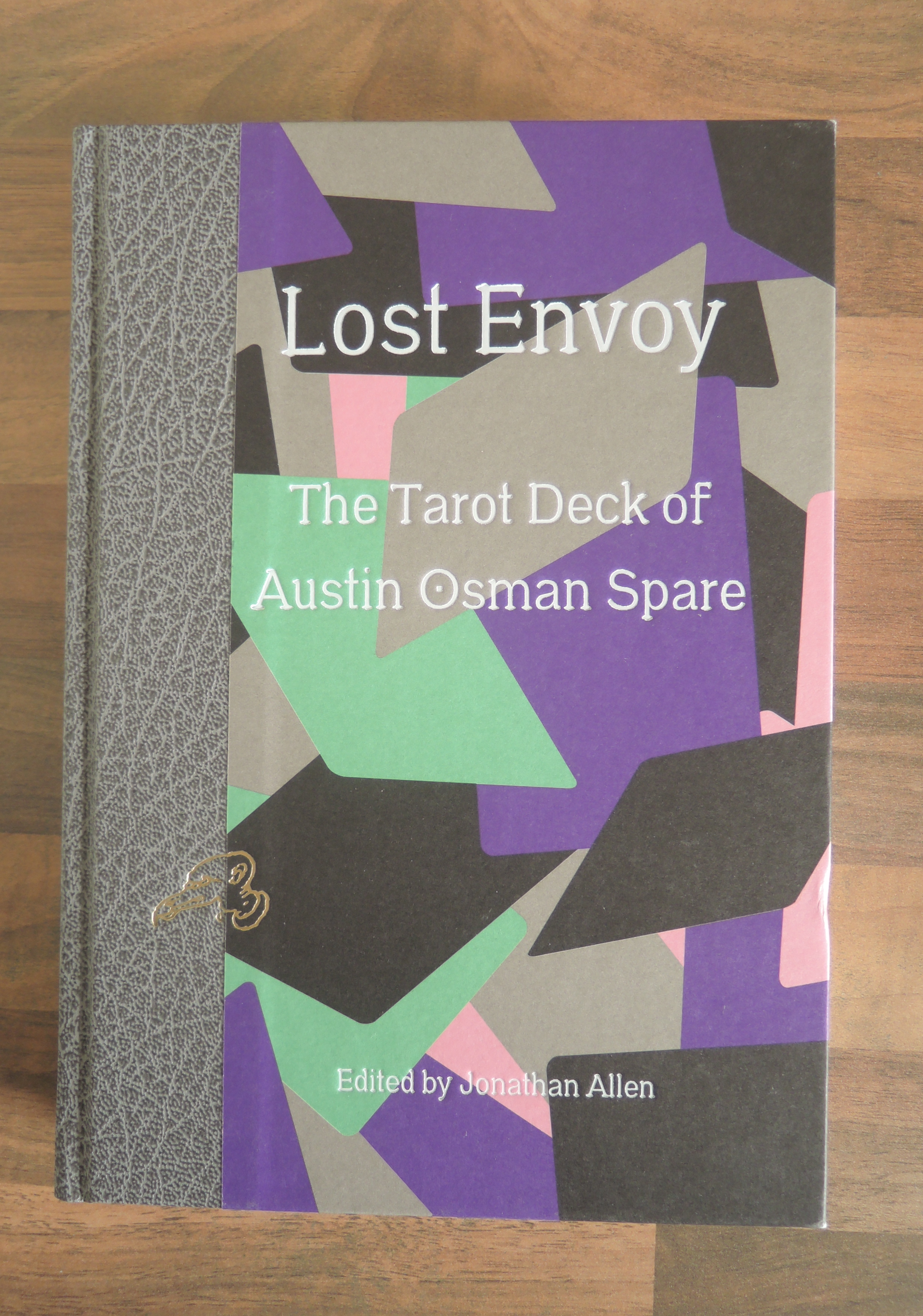
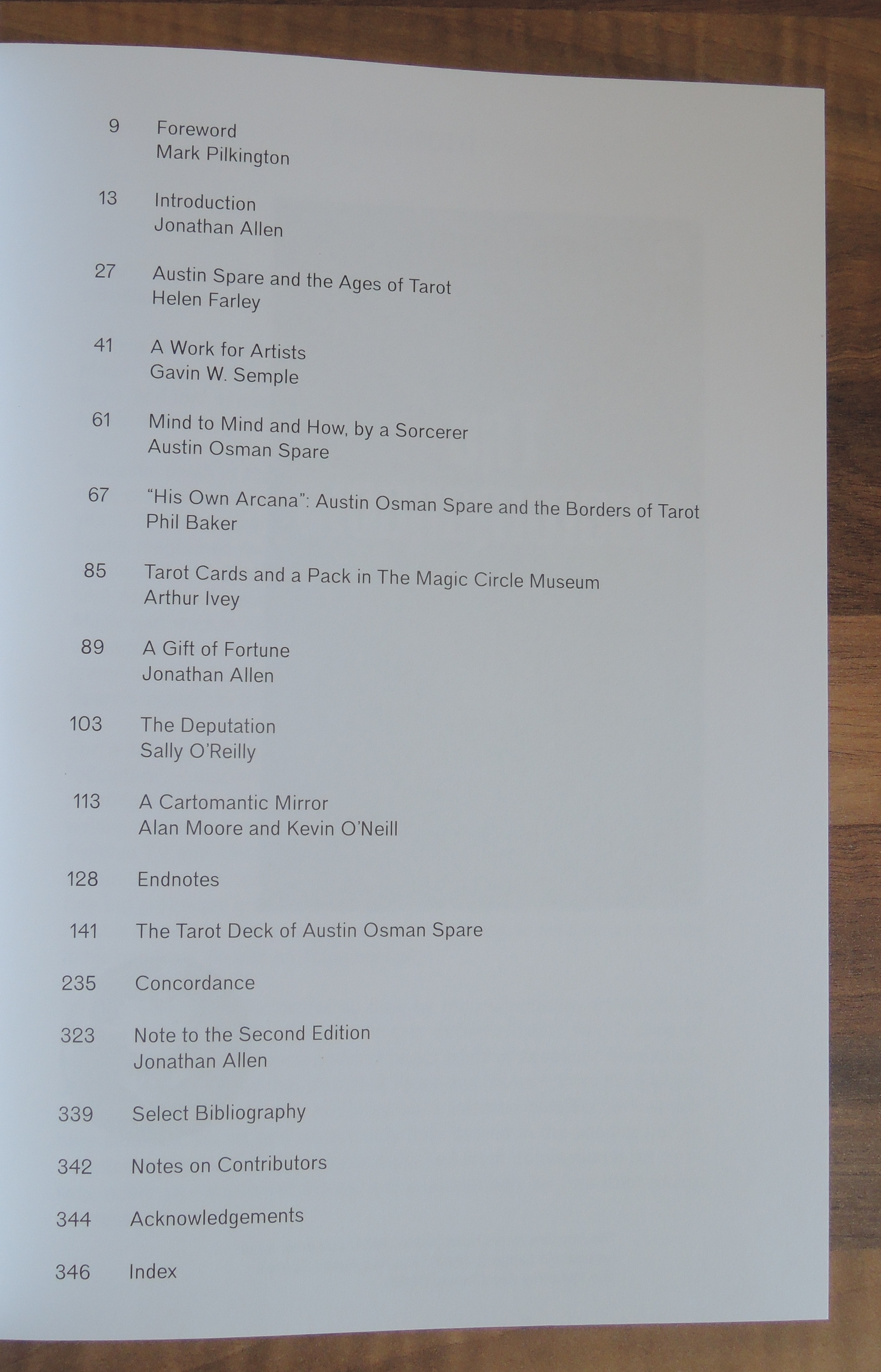
The rediscovery of the deck led to the production of the book Lost Envoy - The Tarot Deck of Austin Osman Spare, edited by Jonathan Allen and published by Strange Attractor Press in 2016 as a limited edition hardcover, which showed images of all the cards of the deck. Lost Envoy was republished by Strange Attractor Press in 2024 (dated 2023) as part of a Kickstarter funded campaign as both an unlimited paperback edition and Kickstarter backer-only hardcover edition. Strange Attractor also produced a facsimile of the Spare tarot deck as part of the Kickstarter campaign which is a historical first.
The Details
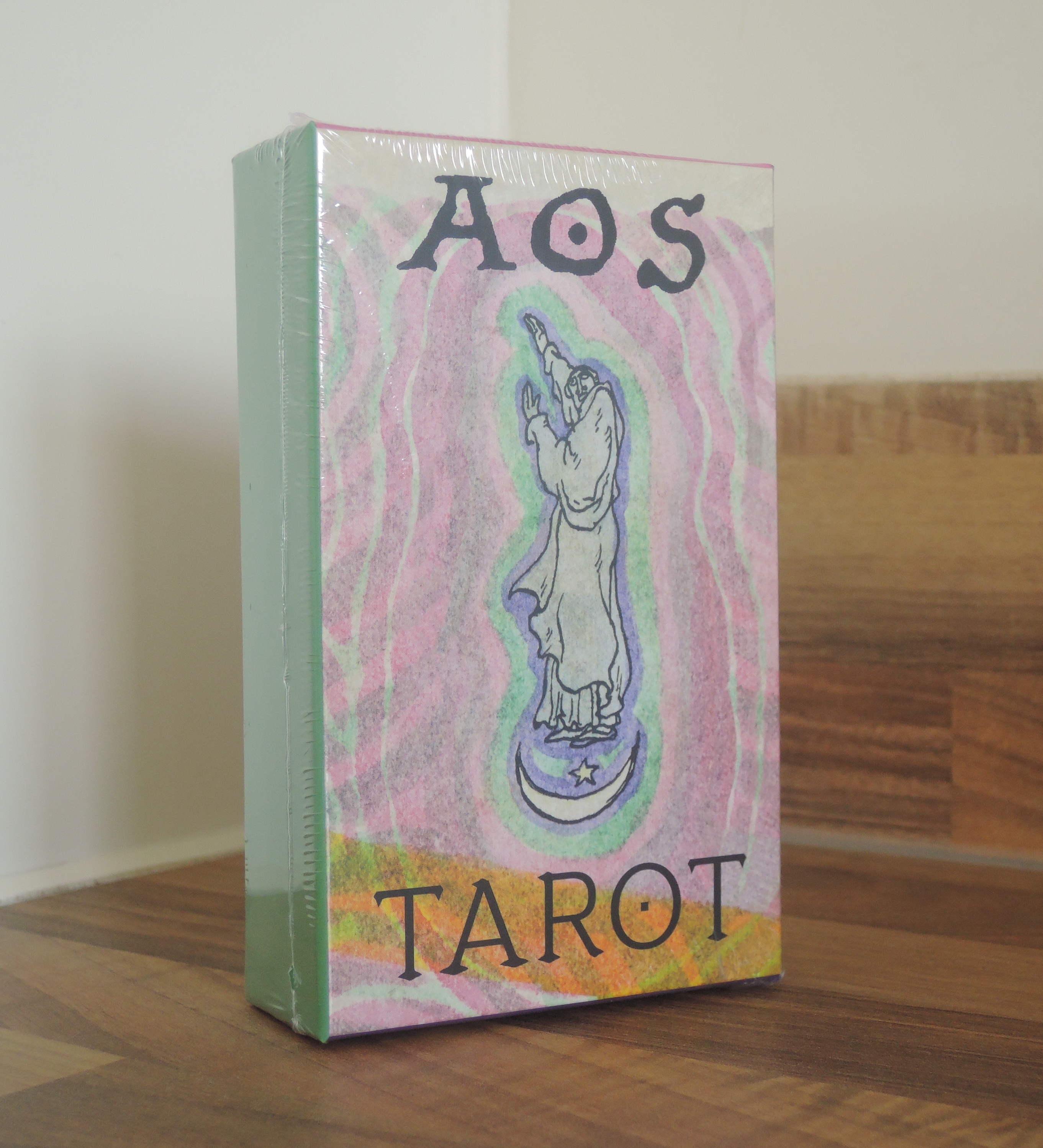
AOS Tarot
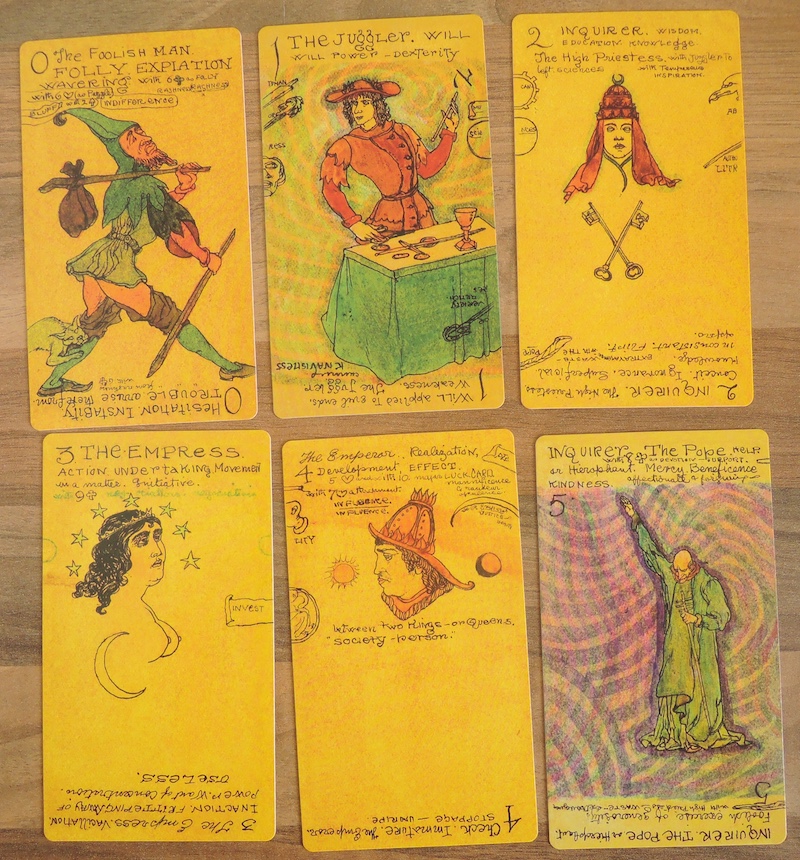
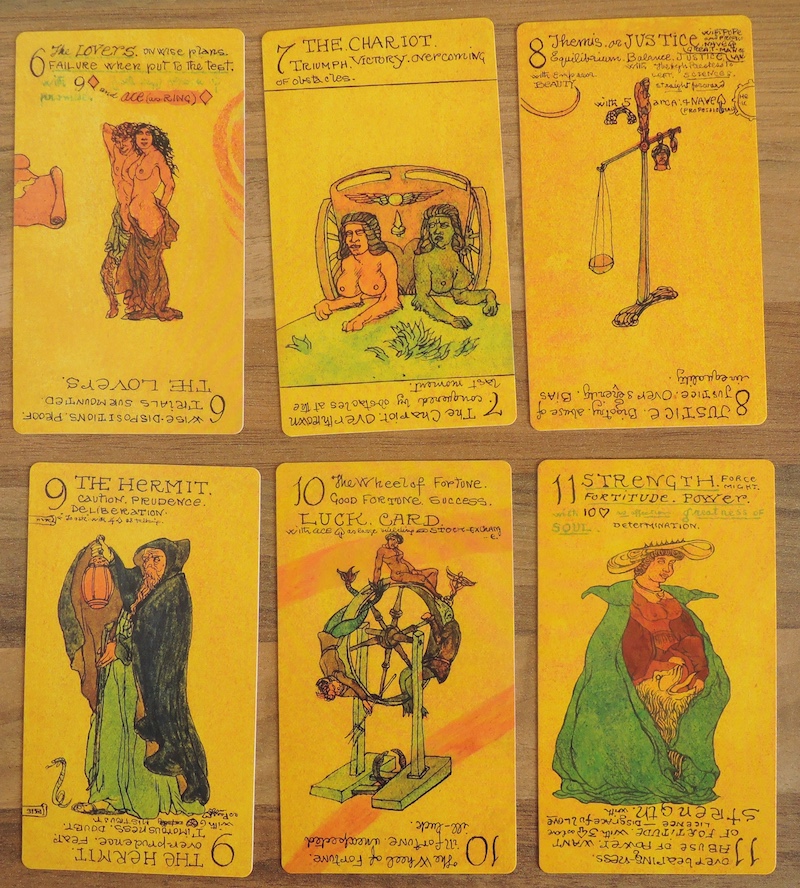
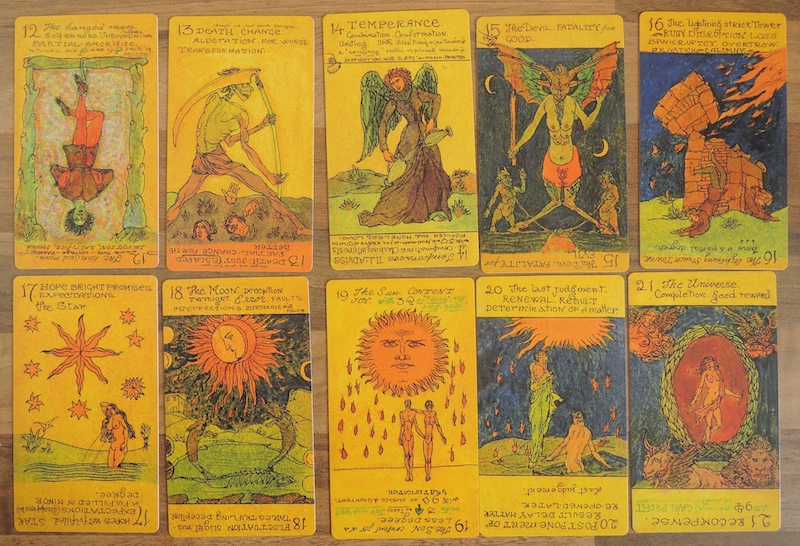
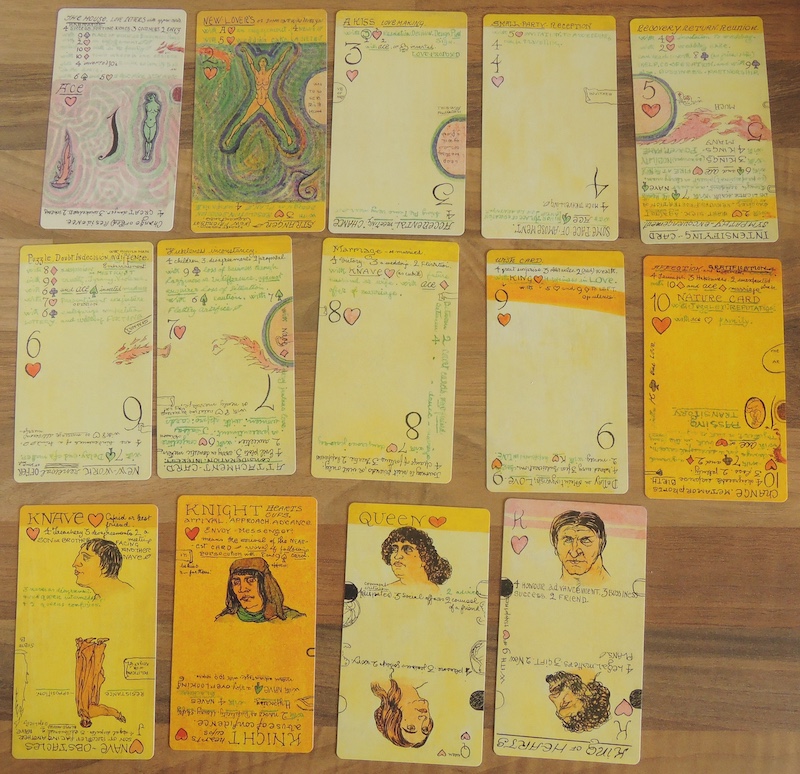
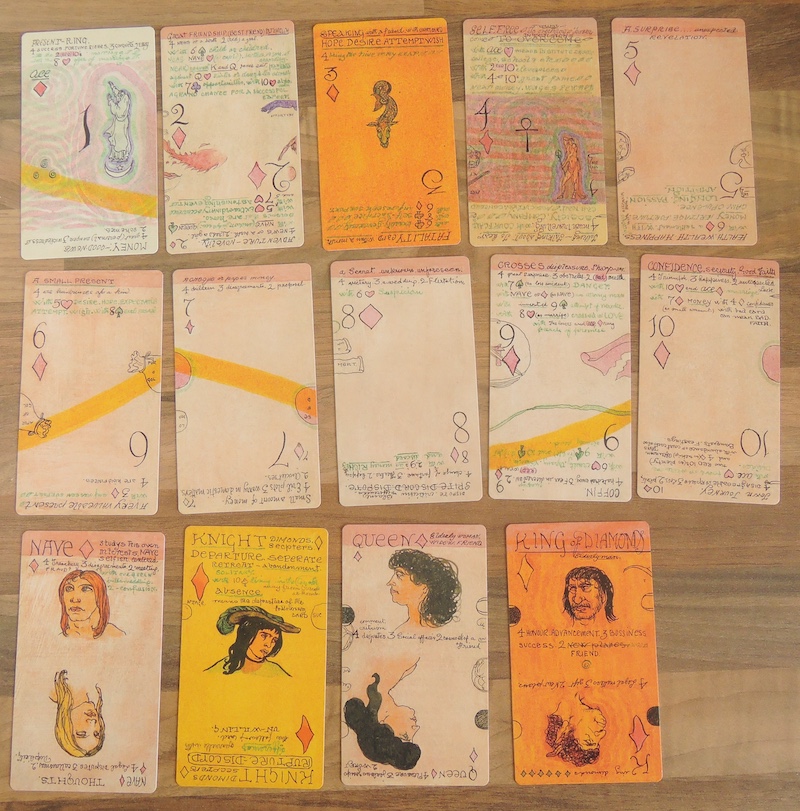
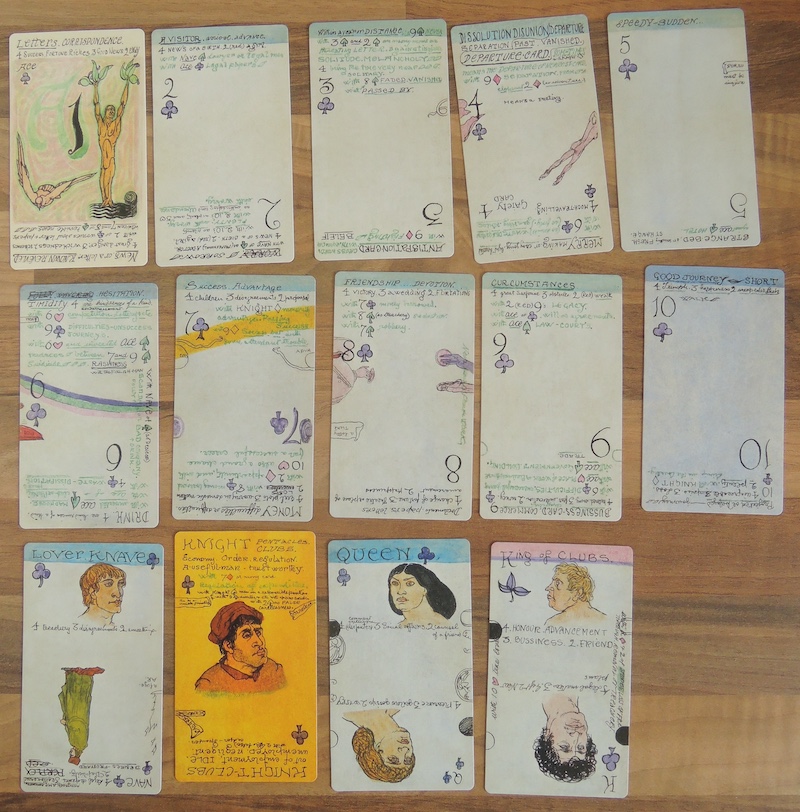
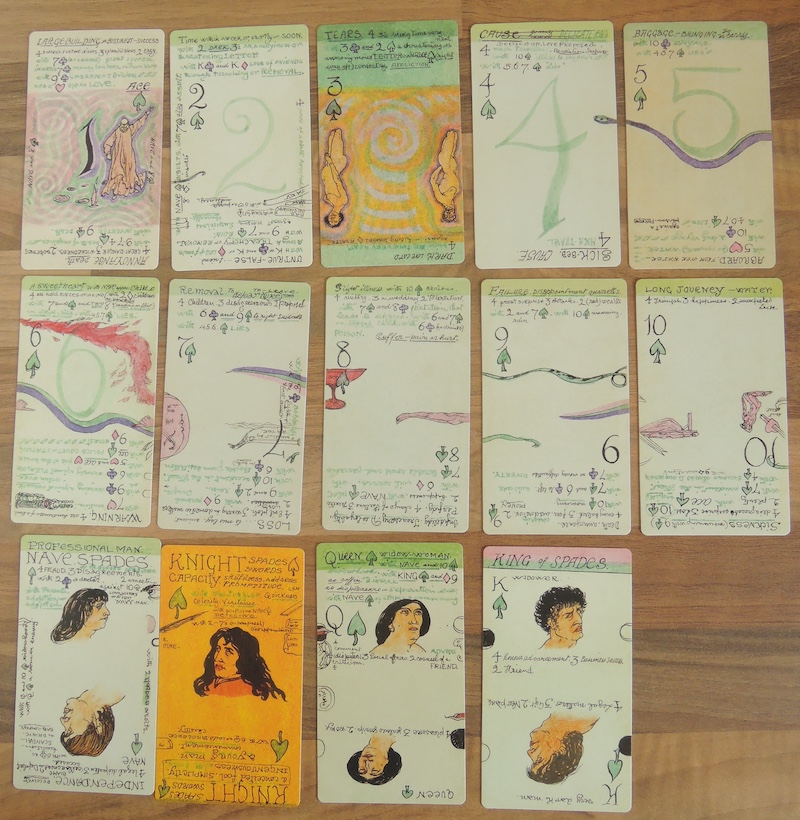
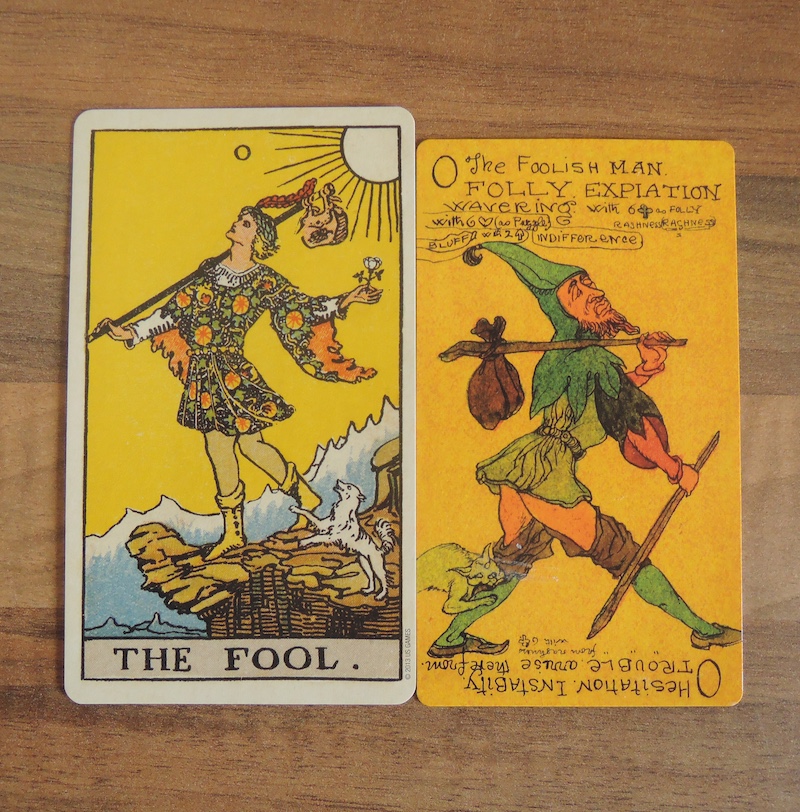
Spare's deck seems to have been influenced by a standard playing card deck, the Oswald Wirth majors tarot deck of 1889 and also the Tarot de Marseille (TdM) pattern, using some of his own artistic symbolism in addition. The major arcana for the large part mirror the symbolism and imagery of the Wirth deck quite closely, albeit more stripped down to the bare elements, but do deviate in certain respects with some cards introducing completely new symbolism, based on some of his previous artwork and aesthetics. The 4 suits of playing cards (clubs, hearts, spades and diamonds) are used instead of the 4 TdM suits (clubs, cups, swords and coins). The aces include naked figures or sculptures and employ more complex background colour details. The deck uses minimalistic TdM style court cards, showing just the head of the figure rather than the whole body and background as you would see in a TdM deck. 3 out of 4 of the court cards for each suit also have a 'reversal' image at the bottom upside down.
Card number 11, Strength, has been lost, exactly when it is not known. However, a black and white photograph of the card still exists, and this photograph was used to produce a colour version of the card in keeping with the colour scheme of the other Majors cards.
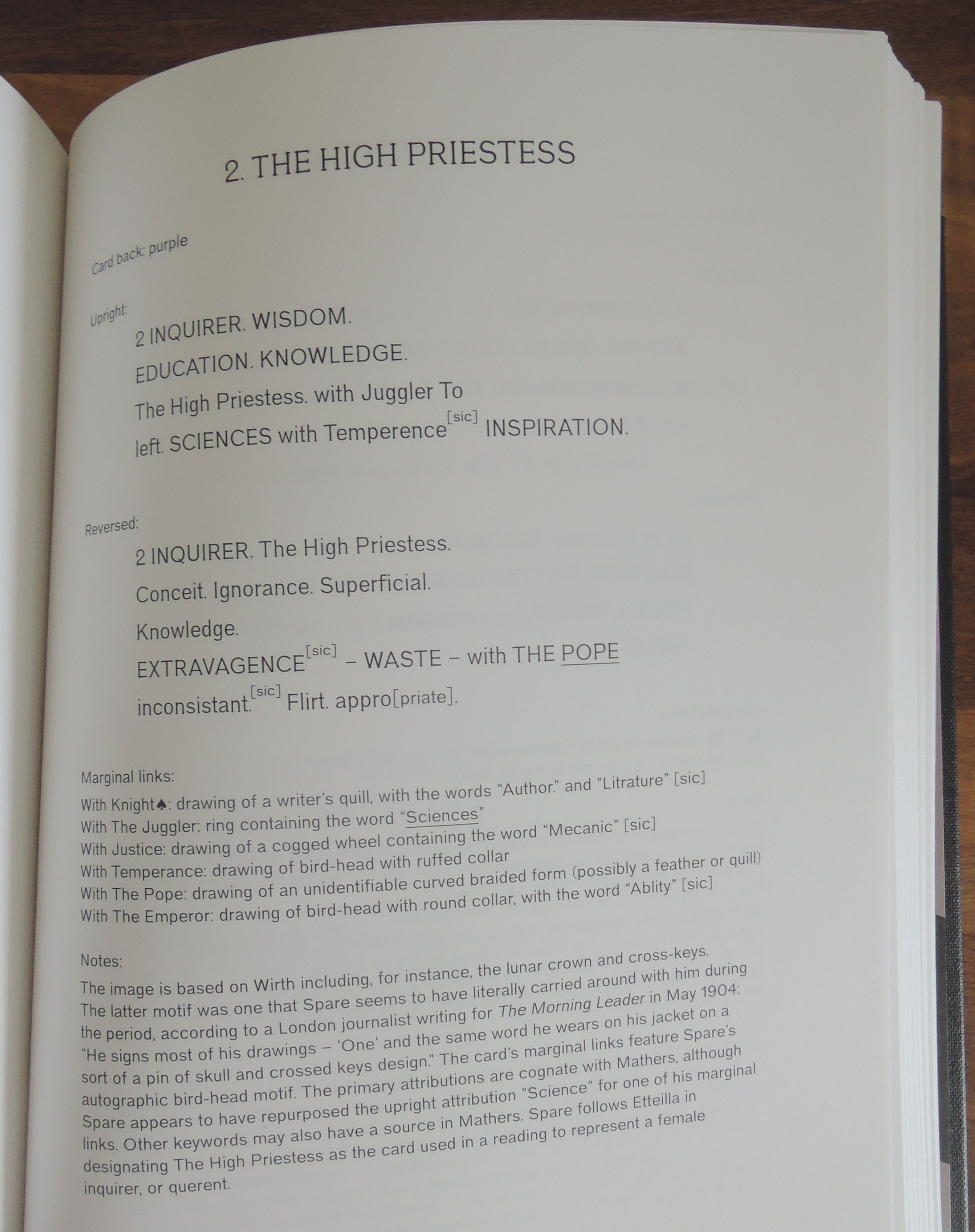
Spare wrote/scribbled the card meanings on the top and bottom edges of the card fronts, including reversal meanings. Some cards include a reversal image at the bottom of the card. It appears to have been a DIY training deck that Spare used.
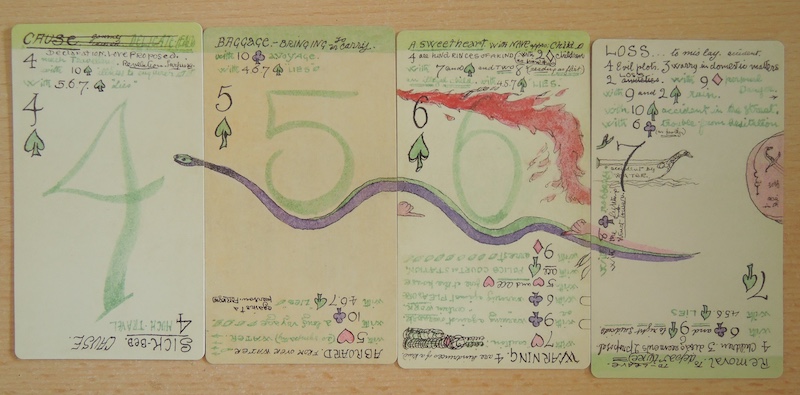
Some of the cards feature additional details on the borders, particularly on left and right, which in some cases align with the details on adjacent cards. The 4 of clubs shows the head of a snake in green and purple, and the body of the snake is featured on 5 and 6 of clubs. The tail of the snake can then be found on the 7 of clubs, but upside down, so these cards would need to be placed adjacent to each other in order to show the snake (with the 7 of clubs upside down on the right side of the spread), which would be very unlikely to occur in a tarot spread from a shuffled deck. A complete study of the deck would really require spending an hour looking for matching designs on the card borders and creating a complete list and trying to then speculate regarding the significance. It may have been a solely playful, aesthetic choice.
The backs of the cards were hand painted a single colour by Spare, using either black, pink, green, purple, although a couple of pips cards were painted a pinkish, greyish, purple colour. They were not assigned their card back colours completely randomly, but neither was it completely logical at least in a way the casual observer can understand. For instance all the majors cards had purple backs, but purple was used on some of the other cards too.
The deck also contains a non-standard black and white 'inquirer' card which appears to draw it imagery from Éliphas Lévi's book Transcendental Magic: Its Doctrine and Ritual, translated by A.E. Waite in 1896.
It is believed by Allen that the card meaning interpretations for the major arcana were lifted straight out of the book ‘How to Tell Fortunes By The Cards: Tarot Method, Teuila Cards, Crystal Gazing, Teacup Lore, etc.’ by Rapoza (1906), which is not exactly the peak of tarot literature of that era. Experienced tarot readers might elect to completely ignore the arguably prescriptive meanings written on the cards and rely on their own experience and understanding, and just appreciate the aesthetics of the handwritten lines.
The card size is 114 x 65mm and deck thickness for 78 cards is 25.5mm. Compared with the US Games' Smith-Waite Centennial Tarot, it is slightly smaller and thinner. The Smith-Waite card size is 120 x 70mm and the deck thickness is 27.5mm.
Lost Envoy
The 2023 edition of Lost Envoy book has been revised and expanded compared to the 2016 edition. The quality of the photographs and images in the 2016 edition also appears to have been improved. The book is partly comprised of a number of essays by Spare scholars, including essays on tarot and the occult revival, about Spare's artistic background, and Alan Moore's look at the details and style of the deck including a comparison with the later Thoth deck. The second half of the book contains larger images of the cards than can be found in the production deck, and it also contains transcriptions of the scribbled notes on the cards, many of which can be rather difficult to read on the cards themselves, although perhaps that is part of the fun! For each card, there is one page containing a large colour photograph of the front of the card, and one page with a transcription of Spare's notes written on the card by Jonathan Allen and also Allen's personal opinions regarding the sources or influences of the symbolism employed as well as the same for Spare's scribbled notes. The main focus of this review is the AOS Tarot rather than Lost Envoy.
Opinion
I do not claim to be an expert on the life and works of AOS nor of the AOS Tarot.
In terms of the actual artwork, the deck as a whole shows off Spare's characteristic line drawing style, especially the faces. The majors have a certain rugged appeal and mirror most closely the Wirth deck in places, although the Spare deck is arguably more interesting, and as a whole I prefer it over the 1889 Wirth deck. The Spare majors in many cases distill the main symbolic elements of Wirth's majors down to the very minimum and leaving out extraneous detail. Perhaps as it was quicker to do so, but this gives the cards a sense of focus.
The pips are fairly minimalistic and in most cases, most of the content on each pip card is just his handwritten scribbles. So there is really not that much extra symbolism on the pips overall over a standard playing card. One or two of the pips are what I would call actually attractive in design with extra symbolism. The aces are much better and show off more psychedelic colour schemes and naked figures or sculptures, the meanings of which are unclear.
The court cards are rather crudely drawn faces but they are characterful and are unmistakeably Spare in style. So they contain less symbolism than Tarot de Marseille court cards. So there is nothing particularly here to provide additional layers of meaning over a TdM deck's court cards, in fact quite the opposite.
There are no Hebrew characters for Qabalah attributions on each card like in the Wirth deck. The meanings written on the cards are in either black or green and give each card more visual interest in my opinion rather than ruining the deck. It gives the deck a rather chaotic, almost psychotic feel in my opinion, which is a positive, albeit probably not what quite Spare had in mind when he created it. As the deck was presumably intended by Spare for private use as a training deck, you could understand the arguably rushed look and forgive the scribbled notes over all the cards. Perhaps the notes are part of the appeal, as whilst making the cards look 'busy', they create visual points of interest. Users may also consider it fun to use Spare's own training deck in the same manner that he himself would likely have used it.
Training decks now are generally only used by beginners as they are not aesthetically pleasing, and most beginners or intermediate tarot users today would I assume in either case prefer to just use a little white book (LWB) guide or accompanying tarot book and look up the meanings rather than have them written all over the cards which really makes you feel like a beginner.
Regarding almost logical way Spare painted the card backs with different colour schemes, perhaps he just made some errors when painting the car backs or perhaps it was an attempt to deliberately cause confusion. Either way, this is unusual for a tarot deck, whereby you would normally want the backs of the cards to look identical to help with shuffling and avoid ‘cheating’.
It would be unfair to judge this deck which was drawn and coloured by Spare whilst he was presumably learning tarot, for his personal use, in comparison with commercially produced decks which were created to be sold to the public or as a private commission for a wealthy buyer. That said, the deck having being published by Strange Attractor, it will attract such critical comparisons. Commercially available training decks tend to be professional tarot decks, like the Smith Waite tarot, reduced in size to make room for added card meanings. Under the circumstances, Spare did a fantastic job in my opinion given the scope of the project, and I believe it does stand up to comparison with commercially produced decks because of his artistic flair. This deck is both interesting from a historical perspective and is sufficiently exciting in its fusion of influences and chaotic artwork style to make it a worthy addition to any tarot reader's library or collection, and in particular existing fans of Spare's artwork and writings. I was initially luke warm or neutral when I first saw images of the deck but it has really grown on me.
However, it has to be said, had Spare had a commission to produce a commercial deck without any design or artistic interference but with an authority on tarot as an advisor, in later years when more occult tarot decks had appeared as sources of inspiration, assuming it would have been something he would have entertained, it would have been quite something and likely up there with the Crowley Harris Thoth deck or perhaps better, at least in terms of style and aesthetic appeal.
The production of the deck by Strange Attractor Press is excellent in my opinion. The cardboard 2 piece box is well executed and attractive enough. The card stock is good. The laminated cards are thin and feel robust. Each original cardback has been reproduced from the original deck, except for the Strength card which was missing; rather than taking one black card back, for instance, and simply duplicating it across all the cards with black backs. The Little White Book (LWB) that comes with the deck provides a good overview of the background of the deck. However it does not include any information that you would typically find in a tarot deck LWB regarding card meanings. However, these are found on the actual cards themselves, even if they can be a little hard to read in places.
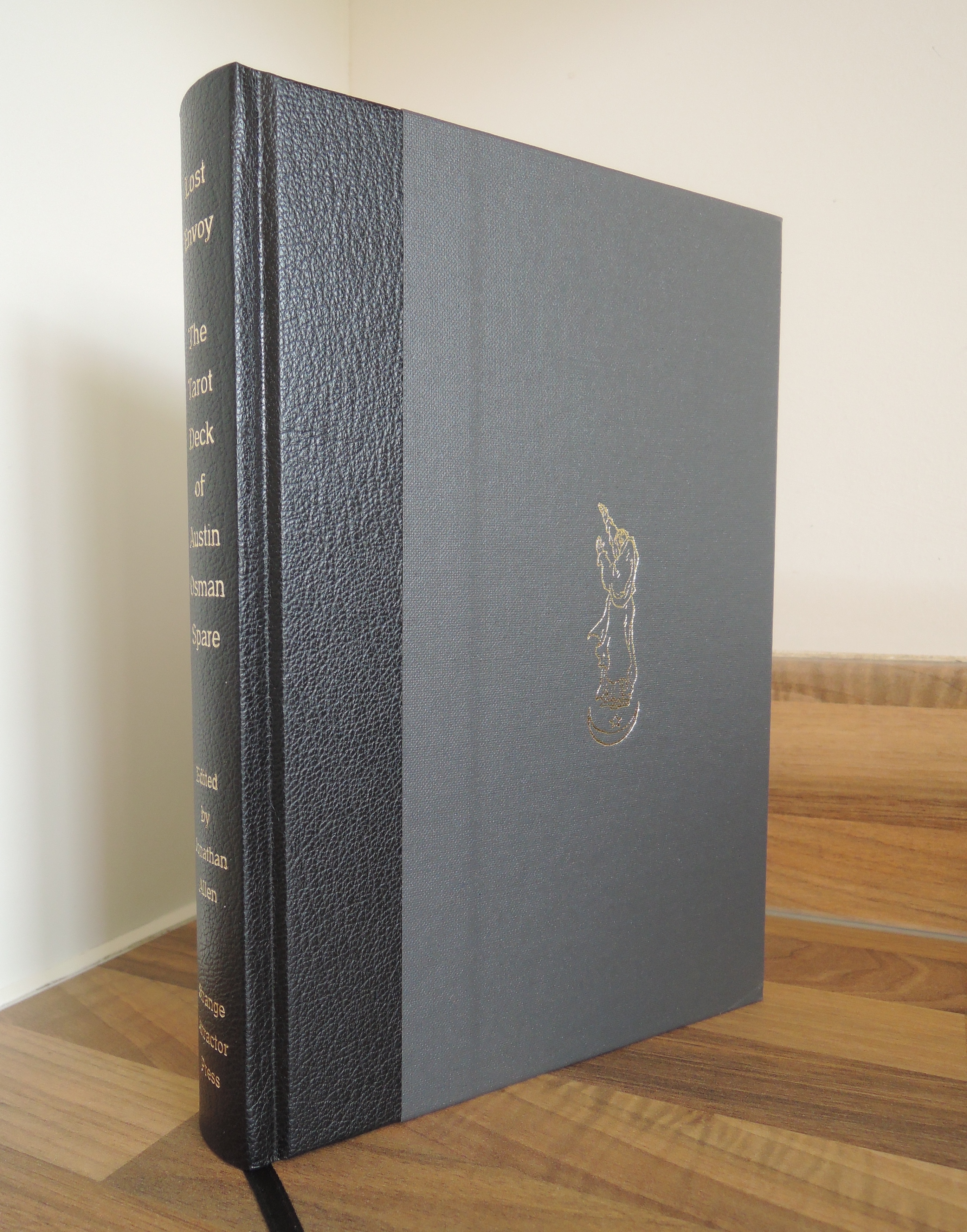
I personally think the cover and binding of the 2016 edition of the Lost Envoy book is far prettier than the 2023 edition, which whilst smart and clean looking, is less exciting with it's quarterbound grey and black look. I no longer have the 2016 edition so cannot provide a thorough comparison. Some buyers might be hoping that Lost Envoy is a 'how to' guide to the Spare deck, with discussion of Spare's card meanings written on each card compared to 'standard' tarot card meanings. However, it is not. So I do not think that the book is absolutely essential for those who want to actually use the AOS Tarot Deck for divination. However it would certainly be extremely useful, especially for those who wanted to study the deck and its images, and those interested in reading about the background of tarot as a whole, Spare and the Magic Circle.
Availability
The softcover edition of Lost Envoy is currently available from Strange Attractor Press as well as a newly launched, limited edition Museum Quality edition of the AOS Tarot.
Photos
|
|
|
||
|
|
|
||
|
|
|
||
|
|
|
||
|